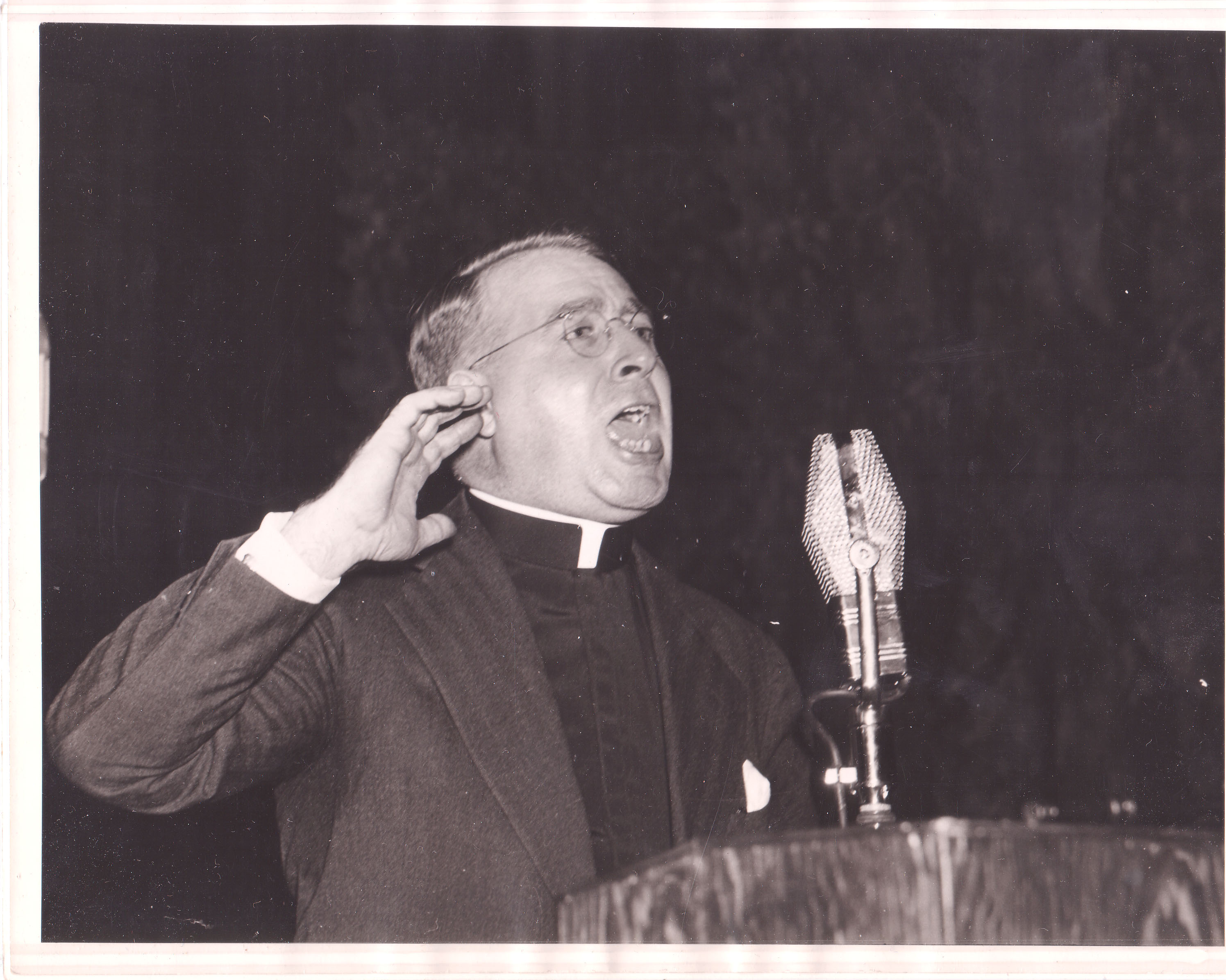
Installment No. 2: Father Coughlin’s Q & A ‘Textbook’ Defines True Wealth, Economy’s Real Purpose
By Mark Anderson
STOP THE PRESSES
Father Coughlin’s talent and credibility as a monetary analyst and writer is especially clear in Chapter II of “Money! Q & A.”
He made sure to clarify that the world’s true, real ultimate wealth is found in God’s creation itself—meaning that we are all heirs to “land, minerals, air, water, sunlight and atomic energy,” as Coughlin put it. It’s a gift from “on high” for everyone, as a public commons. People may own a business, or “shares” in real capital (factories, farmland, scientific and energy facilities and enterprises etc.), but no human being or select group of them owns the earth. Period. Let there be no misunderstanding here.
Therefore, as Coughlin moved Heaven and Earth to make clear, any system that assumes only a super-rich plutocratic minority can or should own the very raw materials inherent in the rock and soils of the earth—and that it’s normal for such overlords to be granted an automatic and unlimited right to have their way with society and steer it as they please—is drastically flawed and on the road to ruin.
Yet, Coughlin in many of his sermons and lectures, in print and on the air, also made it clear that socialism was not the answer either, since socialism involves a government monopoly on the ownership of the means of production; in other words, socialism and monopoly capitalism are economic cousins and are more alike than they are different.
The real answer, therefore, involves a universal form of socially and morally responsible free enterprise without a debt-based money system run by central bankers.
Always careful to lay a solid factual groundwork, Coughlin burrowed down to the absolute basics in his second chapter of the “Money!” book, starting as follows:
1. What is wealth?
Wealth consists of the things persons use to sustain and empower life or to produce the things which sustain life.
2. What are the common forms of wealth?
Food, clothing, shelter, etc.—all things necessary for living.
3. Are there various species of wealth?
Yes. There are material, intellectual and spiritual species of wealth.
Father Coughin continues:
4. Are we [for purposes of the “Money!” book] discussing all species of wealth?
No, only the material. However, be it remarked that social morality, intellectual good and spiritual sanctity are tremendously affected if material wealth is needlessly denied to citizens.
Coughlin’s answer to question number four spells out the key principle that Christianizing society necessarily involves addressing each human person’s physical survival and well-being as a corollary of, or even a prerequisite to, helping them spiritually—which means bringing them to the level of reading scripture, praying and establishing a pattern of church attendance and a relationship with Christ and his Word, in order to assure salvation and eternal life as en extension of our temporal existence.
Indeed, the current hyper-flawed monetary-economic system is a debilitating handmaiden to spiritual sabotage, social unrest, various vices, crime, severe depression and chronic health problems from overwork and myriad other pressures.
Coughlin, as indicated, cites God’s creation as the font of human material wealth and further clarifies that humankind’s economic role is an auxiliary one—which is another key insight for establishing the principle that the only truly workable and equitable way for society to function is for all human beings to be regarded as natural-born shareholders in the world’s natural resources and the benefits that accrue from them.
This view, of course, overturns that hyper-capitalist claim that the “captains of industry” are the absolute owners of natural resources and masters of the economy and, as it turns out, the entire world.
As Coughlin simply put it in Q & A format:
5. From what is this material wealth produced? From the natural resources of creation.
6. Does man produce this wealth? Only in a secondary sense. First, he must have the natural resources which he converts into forms convenient for human use.
7. What are the principal natural resources? Lands, minerals, air, water, forest, sunlight and atomic energy.
Also consider the next two questions and answers, especially the second one:
8. Can wealth be created out of nothing?
No. It is a product of human activity expended upon the raw materials and the sources of everything in creation.
9. What is the purpose of all human activity and industry? To produce and distribute an ever-increasing volume of life-sustaining goods and services.
While number eight essentially challenges the hocus-pocus modern monopoly-capitalist assumption that wealth is mere numbers to manipulate, at will, for the benefit of the plutocratic few, what’s remarkable about number nine is that Father Coughlin teaches the reader that human activity, in this case economic activity, is not, and should never be defined merely as, a means of making money.
One of the world’s core heresies is that money is an end in itself, rather than a means to other ends; this serious philosophical error is the very essence of the “love of money” about which the Bible warns us.
As Coughlin states, the primary purpose of such human activity is to produce and distribute life-sustaining goods and services for human needs; this seriously challenges the widely accepted notion that economic activity is a species of social Darwinism consisting of “survival of the fittest” in a cut-throat competitive environment.
The grim result of operating according to that hopelessly flawed thesis is that hyper-concentrations of money and power in a few hands is inevitable, and, via media and academia, such a dreadful bind is rationalized and then recognized by most people as “normal,” while constant struggle, deprivation and abject poverty—up to the point of starvation—are shrugged off as tolerable “collateral damage.”
As Coughlin readily understood, it’s impossible to ‘ love they neighbor as thyself ‘ as the Lord Jesus commands us, if we tolerate a system that harms our fellow human being—down to the individual level. Didn’t Christ also say that harming the least of those among us is like harming Him?
Meanwhile, media and academia still peddle the often-futile worldview that anyone, if they work hard enough long enough, can “make it rich,” despite the fact that they live in a system rigged to serve the super-rich—in which the vast majority of people are consigned to be wage slaves forever (signing the back, not the front, of paychecks) while selling their labor to employers who in most arrangements can downgrade their pay or fire them at whim.
The bottom line is that those rare souls who aren’t born with the “right’ family and money connections, but still manage to achieve some measure of what’s defined as “success,” do so in spite of modern monopoly capitalism, not because of it. Coughlin also made the important point that there are two distinct forms of wealth—consumer wealth, consisting of products that often are consumed quickly and with regularity: food, shelter, clothing, medicine, toiletries etc.; and producer wealth, consisting of capital items like machinery for farms and factories, factory buildings, engineering departments, assembly lines etc., i.e., the very things that make consumer wealth possible.
And the absolutely most vital point Coughlin makes to wrap up Chapter II of “Money!” is:
“Consumer wealth produced to satisfy every human need IS THE OBJECT OF HUMAN, ECONOMIC ACTIVITY.” (Emphasis added)