World Bankers Defend ‘Brother Powell’ Amid Trump’s Battle With the Federal Reserve
By Mark Anderson
STOP THE PRESSES! News Assoc.
A recent statement issued by major bankers in Europe and Canada, released under the banner of the European Central Bank (ECB), likely wouldn’t have netted much publicity, were it not for these normally quiet financial “leaders” so loudly sticking up for their illustrious American colleague, Federal Reserve Board Chairman Jerome Powell.
These brigands went out of their way to say the only thing they know how to say whenever someone of influence, particularly the U.S. president, expresses doubts that the Fed, or any central bank, should be privately steering monetary policy and, by extension, the overall economy in the direction of their choosing.
Trump’s mention of a criminal probe ultimately concerning the Fed’s handling of interest rates under Powell’s tutelage, especially, sent the bankers into a tizzy.
The heads of major central banks, including the ECB, the Bank of Canada, and the Bank of England, issued what’s been widely described as a “rare joint statement” with “full solidarity,” in order to highlight their timeworn plea that maintaining the Federal Reserve’s “independence” is essential for upholding economic and price stability worldwide; and that they stand with brother Powell amid President Trump’s comments that the U.S. government wants more monetary policy leverage.
Here is the bankers’ full statement (the link at the top of this article connects to both this statement and a list of the bankers who signed it):
We stand in full solidarity with the Federal Reserve System and its Chair Jerome H. Powell. The independence of central banks is a cornerstone of price, financial and economic stability in the interest of the citizens that we serve. It is therefore critical to preserve that independence, with full respect for the rule of law and democratic accountability. Chair Powell has served with integrity, focused on his mandate and an unwavering commitment to the public interest. To us, he is a respected colleague who is held in the highest regard by all who have worked with him.”
FED DEFENDERS ARISE
The American Enterprise Institute, dutifully dedicated to protecting the Fed—given the ties between big money and various think tanks like AEI—is trying to ride to Powell’s rescue via the specious scribbling released Jan. 19 byMichael R. Strain, AEI’s director of economic policy studies and a contributing editor at The Financial Times.
Strain is in over his head from the very beginning, while typifying just about any pro-Fed op-ed you’ll read about Trump’s tug-o-war with Powell and the Fed, to wit:
Thom Tillis, a [soon-to-retire] Republican member of the Senate Banking Committee, showed his colleagues the proper response to the Department of Justice’s investigation of Federal Reserve chair Jerome Powell when he promised to oppose the confirmation of Powell’s successor until the “legal matter is fully resolved.” Powell is facing a criminal investigation over the testimony he delivered to the Banking Committee about renovations to the central bank’s headquarters. This probe is clearly a thin pretext for pressuring the Fed to lower interest rates in accordance with the president’s wishes . . .
Strain’s reasoning falls flat on its face. Firstly, he writes as if Article I, Sect. 8 of the Constitution doesn’t exist, even though it requires Mr. Tillis and every other Congress member of both chambers to “coin money and regulate the value thereof.” And back when the Federal Reserve System was born on Dec. 23, 1913, no Constitutional amendment to legally authorize the Fed’s existence was ever forthcoming.
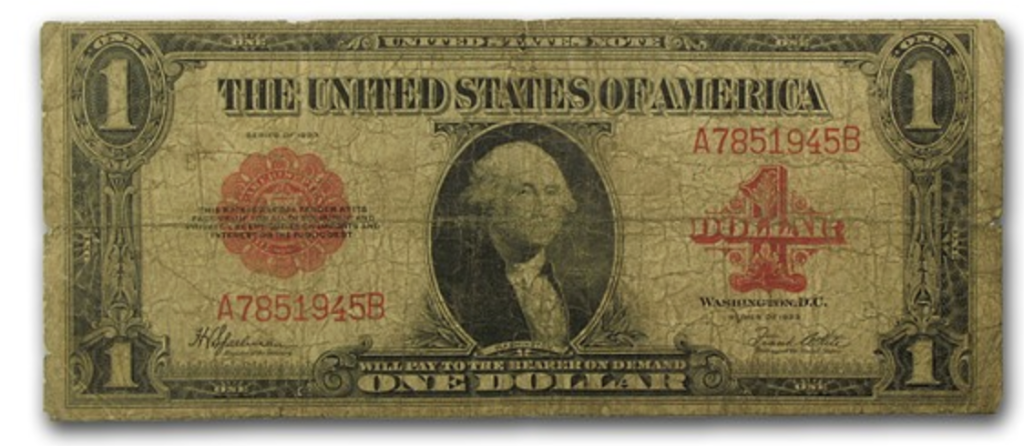
True, it seems archaic and quasi-impossible for Congress to actually do its lawfully-delegated monetary duty. But if the legislature could be brought to basically understand that it need not subordinate itself and print money for the Fed at drastically reduced rates (the Fed pays relative pennies per note regardless of the note’s denomination), then the Treasury could simply spend rather than borrow money into the economy interest-free as United States Notes (see sample below) not the usurious Federal Reserve Notes now being used.
Strain strains to maintain the fiction that Powell shouldn’t be hassled because he’s correct in wanting to keep the control of price inflation within the clutches of the Fed—since it’s supposedly irrefutable that the Fed’s frequent raising of interest rates always reduces price inflation.
Yet, since at least 90% of the U.S money supply is interest-bearing loans, or bank credit, and the Treasury’s cash and coin is 10% maximum, raising rates naturally imposes interest costs that cascade through the economy and, like various taxes, supply costs, utilities, labor costs etc., end up in the final price tags paid by consumers.
“There is a direct line leading from Powell’s potential prosecution to the rate of inflation,” Strain wrote, apparently dismissive of, or oblivious to, the fundamental constitutional-monetary realities cited here, while continuing to recite the usual dark monetary prophecy that investors and businesses will plummet to their financial deaths if the Fed isn’t in total command.
Other Republican senators are defending Powell as well:
• Louisiana Republican John Kennedy, who sits on the Senate Banking Committee, said: “We need this like we need a hole in the head.”
• And Senate Majority Leader John Thune called for the matter to “be resolved quickly” and affirmed his support for Fed independence.
“Powell’s term as chair expires in May, but he would remain in office until his successor is confirmed,” Strain added. “Refusing to confirm Powell’s successor until this investigation is dropped could make Trump think twice about weaponizing the justice system in the future. . . . When the dust settles from this shocking episode, the Senate could emerge stronger by asserting itself and forcing an end to the Powell investigation—and by ensuring that Powell’s successor is independent of [the White House’s whims].”
Strain also used the words “hyper-active and unchecked president.”
Or is Trump a rightfully concerned president trying, perhaps a bit awkwardly, to make some key constitutional changes? That question simply won’t be asked.