Installment No. 1: Father Coughlin’s Q & A ‘Textbook’ Offers Keen Insights into Our Money Woes
By Mark Anderson
STOP THE PRESSES!
This first installment of an overview of a special book written by the late radio priest Charles Coughlin represents, in part, a sneak peek at some of the content in Mr. Anderson’s upcoming book: COUGHLIN, CHRISTIAN SOLDIER
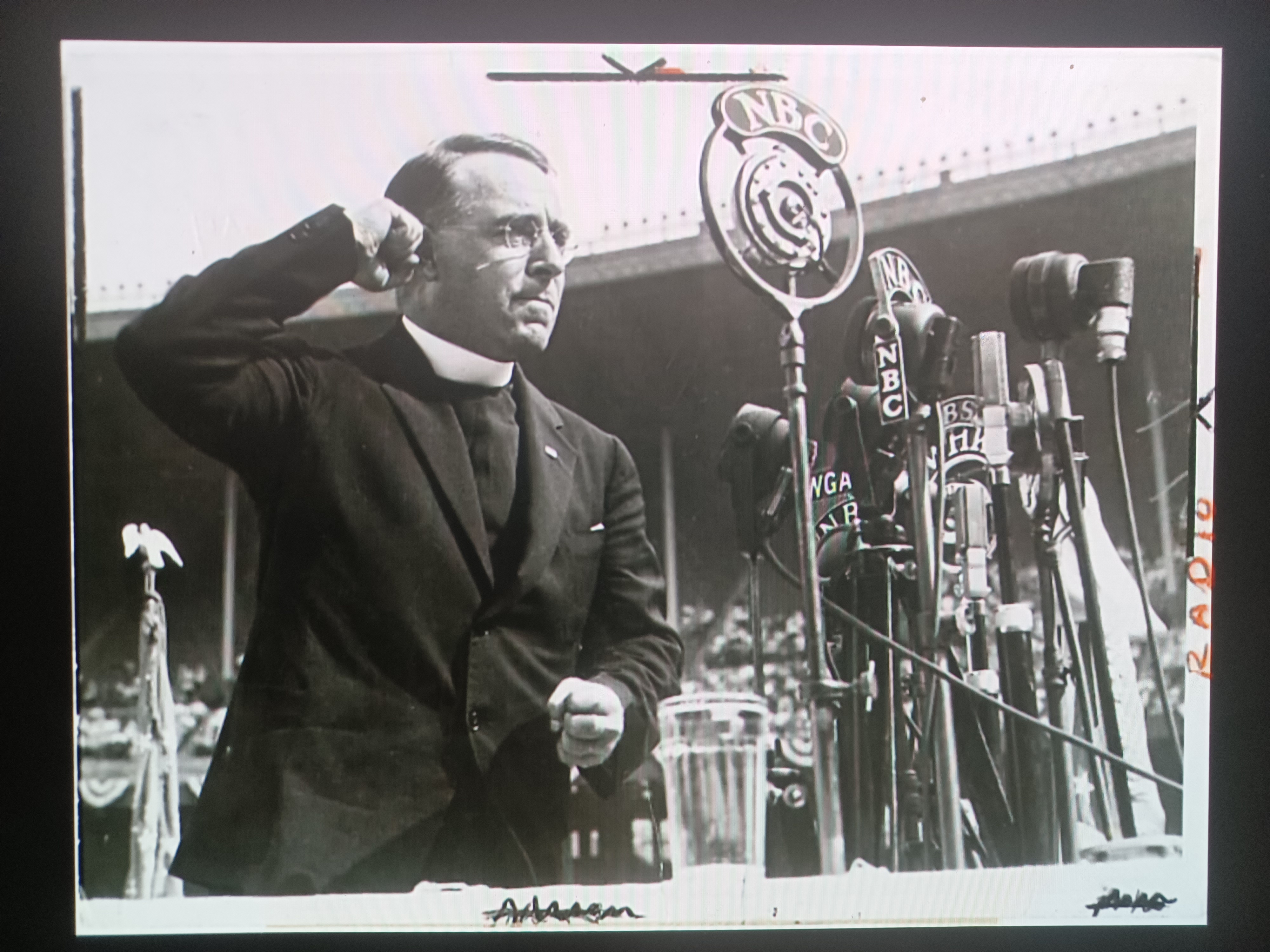
“Money! Questions and Answers” is perhaps the most important book by the late radio priest Father Charles E. Coughlin (1891-1979), as it’s apparently the only book with his byline that isn’t a compilation of his radio speeches and sermons.
In “Money! Q & A,” the Canadian-born cleric who rocked his home base in Royal Oak, Michigan and the nation at-large to the core during his heyday on radio, from the late 1920s until the early 1940s, cites as his book’s basis America’s constitutional arrangement that empowers Congress, not private bankers, to determine monetary policy.
That policy is predicated, of course, on Article 1, Sect. 8, Clause 5 of the U.S. Constitution, which requires that Congress:
. . . shall coin money and regulate the value thereof, and of foreign coin, and fix the standard of weights and measures.”
Even Chat GPT, which is fast becoming the online mainstay of publicly accessible artificial intelligence, acknowledges Congress’s real (but surrendered) power in this critical financial function, noting:
Congress has the exclusive right to coin money, meaning that states cannot create their own,” thereby ensuring “a consistent currency across the nation, vital for commerce and trade.”
COUGHLIN’S CLASSROOM
Importantly, “Money: Q and A” is written with a classroom-like format. To this day, even though it was released in the 1930s, this “textbook,” if you like, still could be used for homeschooling or adult-education courses, among other applications. But most significantly, it’s a work of respectable depth, accuracy and scholarship—way beyond what you’d expect from a man of the cloth.
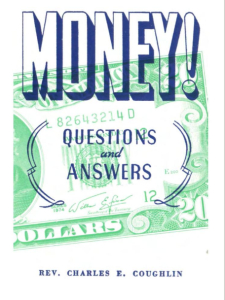
The book (see copy of its cover here, a 1970s reprint) therefore stands as a solid testament against the well-documented parade of Coughing bashers who, as if it needs repeating, hyper-ventilate about Coughlin’s so-called demagoguery, amid the constant implication that he did not offer his radio listeners anything of substance or lasting value. Nor do Coughlin’s critics even acknowledge that he produced “Money: Q & A” or compiled other books in the first place.
Interestingly, and it’s not clear whether Father Coughlin fully realized or mentioned it explicitly, in the very year that he started his assigned solo priestly duties in Royal Oak—that year being 1926—America had reached the 150th year since its Declaration of Independence. And Coughlin implicitly realized, perhaps more than any other human being before him, or since, that true independence can never happen in a debt-based system, no matter how many muskets and cannon are fired, no matter how many naval ships sail, how many “enemy” soldiers are slain, or battles won.
Accordingly, Coughlin spoke and wrote about the American colonists prospering because they issued, for a time, their own debt-free currency, with such splendid results that word soon reached the thoroughly annoyed British Crown—which sought to undermine this newfound independence by counterfeiting the Continental Currency in large amounts that watered down its effectiveness.
Thus, via this “Money Q & A” book, Father Coughlin laid down the gauntlet, showing that he was not a mere accuser and harbored insights that could saw through the shackles of an economic slavery that snared anyone of any color, in all places and all times—a universal despotism of the most terrible kind imaginable.
BOOK’S CONTENTS
The two over-arching themes, or Lessons, in “Money! Q & A,” apart from introductory remarks and a detailed appendix, are:
1 — MONEY AND BANKING; and
2—THE OPERATION OF AN HONEST MONEY SYSTEM
In the first of those two Lessons, which consists of 11 sub-sections, the most crucial point to take into account is that Congress, whose power of the purse for both budgeting and creating and regulating the currency are constitutional cornerstones, simply cannot delegate such powers to the private sector without breaking the law in the most fundamental, egregious sense imaginable.
And while Coughlin’s book clarifies that the Constitution can of course be amended (through a process within the Constitution itself), the bottom line is that the Constitution was never even amended to allow for Congressional transference of its money-creation authority to the private sector, in this case the Federal Reserve System, via the passage of the Federal Reserve Act on Dec. 23, 1913.
Question (and answer) Number 7 in Lesson 1, which starts exploring this angle with a more general approach, reads as follows:
Q — If the people, through the Constitution, hand over to Congress, for example, any power over the people’s sovereign right, does Congress have the power to transfer this right, without specifications or limitations, to any group of private individuals?
A– No. By the decisions of the Supreme Court, this is not permissible.
Additional Q’s and A’s add even more fuel to the fire as this book quickly zeros in on the utter unlawfulness and treachery of Congress giving private bankers the proverbial “keys to the kingdom” in terms of enabling such outside interests to issue and control the nation’s currency and credit under the mere color of “law.” This gave everyone the ultra-false impression that the banking fraternity had a monetary authority that it does not and can never possess.
Here is Question Number 18:
Q– Since an honest money system is necessary, did the Framers of the Constitution intend to provide for only part or all of the money necessary to effect exchanges?
A — Being learned men, if they were providing for only a part of money, they would have said so. Being just men, if they were providing an honest money system, they could not allow a privileged few the right to substitute their private money for honest public money.
Here is Question Number 19:
Q — Would the Constitution have provided for an honest money system if a privileged few were to have the right to substitute private money for money coined by Congress?
A – No. It would have violated the first rules of an honest and democratic system, if a few privileged individuals were granted the right to substitute private money for the nation’s money.
And here is Question Number 20:
Q — What, therefore, are the money provisions of the Constitution of the United States?
A — Article I, Section 8, Part 5, reads: “Congress shall have the power to coin money and regulate the value thereof; and of foreign coin.” (It is obvious that the Framers of the Constitution and the people who adopted it were providing for all of the money, not only that originated in this country, but also for the regulation of foreign coins that might be brought into this country to be exchanged for dollars).
HUMAN NATURE A KEY FACTOR
And while Coughlin correctly noted early in this “Money!” book that the Constitution “is a just document,” that it’s “founded on human nature,” that “human nature is social” in many respects, and that “the social aspect of human nature requires an exchange of goods,” all of this inexorably means that the vitally-necessary exchange of goods and services in the course of human existence requires money in order to live beyond an awkward barter system and efficiently survive and thrive well into the future—on the basis of, and fueled by, God’s providence in Creation itself and the raw materials our Heavenly Father bestowed upon us.
Thus, as Coughlin noted, the Constitution, if faithfully followed, could be a handmaiden in following God’s Will, ensuring that an honest money system, and not the grand swindle bestowed upon us by the brigands of banking, would be firmly in place forevermore so that God’s plan can come to full fruition and justice can rain down upon us all.
In the next installment on Father Coughlin’s “Money: Q & A” book, here on Mark Anderson’s “Truth Hound” website, the nature of wealth and the nature of money, two items that are inextricably linked, will be explored in terms of Coughlin’s solid grasp of such matters. Some highly vital insights into the relationship between Congress and the Federal Reserve are to be included.